I have somehow taken, inherited, or otherwise acquired a massive number of photos. They come from homes we’ve had to pack up and empty over the years – my mother’s, my grandparents’, my mother-in-law’s. As I sit in my home office, I am surrounded by piles, and piles and yes, more piles of photos – fortunately, I’ve left myself a narrow escape route to the door. I’ve sorted them into my own weird categories – my childhood photos, my husband’s, my grandparents lives stretching from youth, to marriage, to old age. There are pictures of all the cars and houses we’ve owned, my brother’s family, our wedding photos, dear friends and trips we’ve taken. The old sepia prints of the ancestors are quite beautiful; some date to the turn of the last century. There are pictures of my dad as a boy, of my great grandparents as newlyweds; there are vast amounts of me as a baby (I was the first grandchild on both sides of my family, so, of course).
I can’t keep all these – they take up way too much room, and we are, supposedly, trying to downsize forty years of accumulated stuff. To help figure out how to get rid of photos logically, I’ve read a jillion articles about the best way to do it. They all say ‘get rid of landscapes, get rid of people you don’t recognize, duplicates, photos that are blurred, ones where someone’s eyes are closed, or the composition isn’t great.’ The last one got me – who did the writer think was taking those old family photos? Diane Arbus? Ansel Adams? Most likely, it was someone’s cousin or your grandma. They didn’t care about composition – they just wanted to capture the moment, hoping it would preserve that memory for themselves and their children. And, in the days before iPhones and digital photography, you wouldn’t know, couldn’t know, whether someone’s eyes were closed till you got your photos back from wherever they got developed. That used to be kind of fun and surprising. You got that envelope full of 4 x 6 prints along with the negatives (I’m not going to explain negatives to anyone under the age of forty), and you’d find that you cut the top of your dad’s head off in the family photo, or somehow you took a shot of your feet, or the inside of your purse. Blurry images and bad composition my eye – sometimes those were the best ones out of the lot.
So, how do I get rid of some of this mountain of photos? Do I toss the picture of me as a toddler in my dad’s arms because it’s a little out of focus? Do I discard the photo of my brother and me as teenagers because one of us is making a funny face (it wasn’t me)? There just aren’t that many pictures of us then, so that’s going in the keep pile. Or a photo of my grandparents standing stiffly beside me in one of those oddly saturated color photos of the. We look like we’re ready for a military inspection, but I don’t care – that one’s in the keep pile, too.
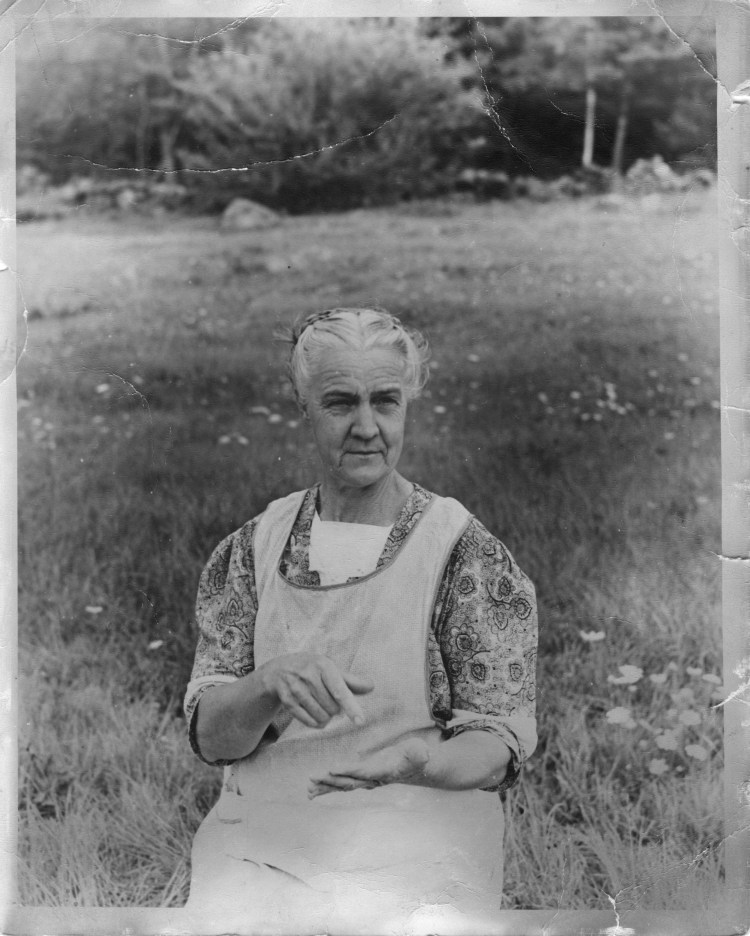
There’s one photo in particular I love. It’s of my husband’s great-grandmother, a woman I never met. It’s a sepia print; she’s probably in her fifties or sixties, and her face is lined with wrinkles she must have earned from smiling a lot. Her hair is done in a neat bun, and you can see a hint of the braids on the top of her head, little wisps of hair have escaped the braids and soften the effect. She’s wearing a faded work dress in a homespun print with an apron over it. There are cracks and splits in the picture; there’s too much background above her head. It probably should be tossed, based on the experts’ criteria, but I am keeping it anyway. Because, when I look closer at her face and ignore the poor composition, the tears, and the fact that she’s not posing with a three quarter profile, there’s something in her face that compels me to look at her. She has the hint of a smile, and is staring off into the distance. She has her left hand held waist-high, palm up, and her right hand has her index finger pointing at her right hand. It’s as she’s trying to make a point about something. Maybe explaining a recipe for biscuits, how to iron a sheet the right way, or pointing out the best time to gather honey. I can’t look away from her – I want to know what she was saying, to see what she was looking at. Throw that picture away because of a set of rules and criteria on the best photos to keep? Nope. It goes in the keep pile, too.
 J. Gardner Hurd